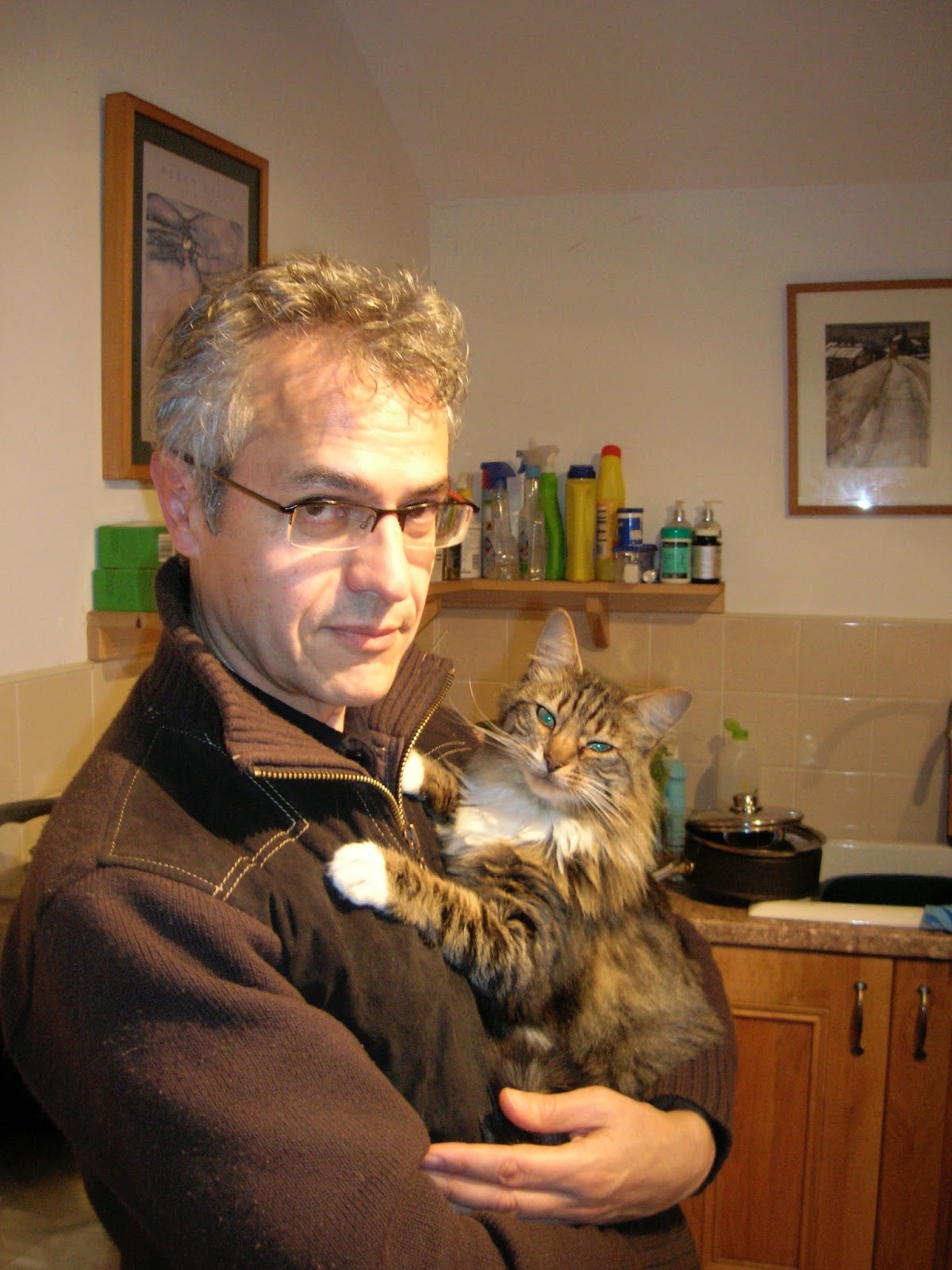
I should not delay any longer writing a tribute to this other cat. Time is moving along and soon this diary’s claim to being “a composer’s impressions of life in rural Northumberland” may start losing credibility, becoming more of "a composer's memories ...". And, speaking of memory, my recollection of details will turn fuzzier, as is happening already, at least on some of the matters of secondary importance.
As many people know, K is a lover of cats. She has had a succession of them, each leaving an indelible mark in her psyche. At the time Rumble’s story begins, or rather in the story’s prologue, this cat love was well catered for by two strong, interesting individuals: Douglas and Tiger, each of them eulogised in their own entry elsewhere in this diary.
But one of K’s friends, an extraordinary musician working abroad (I don't know if she would like to be named here), seemed to hit on the idea of amusing herself with K’s weakness for cats. She - the friend - began to send random pictures of cute kittens, with thinly veiled allusions to the joys of having a kitten. K played along, knowing it was all a big joke, although perhaps a slightly cruel one. One of these images was from an advert about two young siblings from Hexham, going free to a good home. One of them looked conventionally pretty, with a tabby pattern of silver and white not unlike our existing half-Bengal; the other was a curious kind of kitten, with a face where black, white and brown patches combined in what looked like a harlequin mask.
The sustained campaign of photos and hints must have worked its effect on me, since I volunteered to drive to Hexham to meet the siblings. I took very young human company with me, guaranteeing an intense experience. At the siblings’ house, we were told that Mr Harlequin was spoken for already, but that Mr Tabby was still available. We met Mr Tabby, we stroked him, he purred, we said we would consult, and we left. We reported our findings to K when she came home. Still not sure of what we were going to do, we all drove to Hexham. K must have found Mr Tabby satisfactory, since the drive back home was with Mr Tabby in the car. His purr was so uninhibited, so profuse, that there was only one possible name for him: Rumble.

Rumble proved a sweet cat. He purred, he played with the girls, he tried to be civil to the other animals, even though Tiger did not welcome him. Indeed, the newcomer’s arrival exposed a mean streak we had not known in Tiger. In spite of Rumble’s evident disadvantage in size and strength, Tiger hissed and made as if to attack him. Little did Tiger know that she was digging her own grave with this behaviour; it would not be forgotten.

But right now Rumble was the undercat, and he needed protection and affection. He got them, and, inexplicably, he seemed especially receptive to affection from me. And I seemed to have something of a soft spot for him too. “He’s your cat!” K would say, with surprise but without a trace of envy.

As he grew, Rumble lost the cute kitten’s endearing qualities, but Tiger’s relentless hostility toward him and a certain nerviness in Rumble’s developing character endeared him to me. Maybe he was my cat. Then came the issue of Rumble’s gender.

As he grew, Rumble lost the cute kitten’s endearing qualities, but Tiger’s relentless hostility toward him and a certain nerviness in Rumble’s developing character endeared him to me. Maybe he was my cat. Then came the issue of Rumble’s gender.

It would take only a little dose of poetic licence to sum up the story thus: when he seemed to have reached the right age and size, Rumble was taken to the vet for neutering. “I cannot neuter this cat” was the vet’s reaction. “because he is in fact a she”. As if this were not surprising enough, he added “and, moreover, she is pregnant”.
The combined news of gender reassignment and early pregnancy came as a minor bombshell. Rumble female? Rumble pregnant? The mind reeled. Some psychological realignment was required of us, and some of us did not quite manage it. Rumble had come to us male, had behaved like a male (whatever that means) and I found it hard to alter my idea of him. He would stay male for me, even if he was pregnant. This was to cause some disagreements within the family, particularly with the young contingent, but only as regards terminology. We were all determined to support Rumble through pregnancy and motherhood.
Rumble’s bulk increased only slightly, but his temperament altered. He became nervier still, as if always on the alert for danger, both in and outside the house. We guessed that he might be fearing a return of the cat who had stolen his virtue. And, of course, danger was only too real in one respect: there was an enemy within. It was not long before Rumble stood up to Tiger, hissed back and, where necessary, used his claws in self-defence. Mindful of his delicate state, we were quick to support Rumble in cases of conflict, putting Tiger out of the house. To what extent her repeated evictions hastened Tiger’s self-exclusion we will never know.
As full term approached, Rumble began moving heavily and with an exploratory attitude, as if looking for the right place. K made preparations for catbirth: a cardboard box with cushions and old clothes for comfort. A balance between spaciousness and the private confinement cats like was sought. We rehearsed various locations; I am not sure we had agreed a final one, when Rumble took her own decisions. Although he had been showing a partiality to me, Rumble began to follow K around. There was little doubt who Rumble wanted for midwifing duties. And he chose not the specially prepared box, but a dark corner in a wooden wardrobe in our bedroom.
It was a dramatic time and I wish I remembered more of the details. Were this a piece of fiction I could add in touches for atmosphere and transitions between the scenes. But this is a diary, and I must stay close to the facts as I remember them.
The next scene memory records is of K kneeling down and bending over into that wardrobe, taking one kitten after another, in slow and painful succession, out of the dark and into the cardboard box. I cannot remember the order of appearance; only that four kittens came out, of various sizes and colours, and that after prolonged labour both K and Rumble were about to breathe their relief, when they realised that all was not yet over. Needing some extra help from the midwife, a little afterthought came out. This was the quintessential runt of the litter, and very unusual colours it had too.

The naming of the kittens was straightforward, even though some of them took a bit of time to settle into their names. Our young contingent had, of course, a part to play. Ginger was uncontentious; so was Stripy. Mackerel had an earlier spell as Snaky, but he grew into Mackerel. Baby Dee obeyed some reasoning of K’s I never quite followed. The little runt, for whom K was quick to develop a special affection, was named Tiny.
Life was a riot with five kittens, three grownup cats and one dog. The children amused themselves endlessly with the kittens, cuddling them, talking to them, teaching them their names, devising toys for them, teaching them how to use the toys and so forth.

Rumble turned out to be a surprisingly devoted mother. In spite of his modest size and, surely, limited milk-production capacity, he made himself always available for feeding, and the kittens showed insatiable greed. He was less solicitous with the grooming, but he did some of that too. And he was, of course, fiercely protective of the kittens when Fluffy the dog or Douglas the cat came anywhere close. As to poor old Tiger, he knew by now it was best to make herself scarce and to stay that way.

Soon I began to feel sorry for Rumble. Having coped with early pregnancy, he was now a long-suffering mother of five. The children’s attention had switched to the kittens, depriving Rumble of his former role as the spoilt darling. His childhood had been short, and his premature adulthood was marked by the strife with Tiger.
I should have been a stauncher defender of Rumble, were it not for his attitude towards Tiger. What had started off as Rumble’s legitimate self-defence, soon after the kitten’s birth became a vicious animosity. Rumble was now no smaller than Tiger - if one discounts the latter’s fluff - and Rumble revealed a fearsome streak. He would hiss, growl, cuff and chase until poor Tiger was a helpless wraith. This dented my affection for Rumble, at the very time he most needed it. I do regret that now, Rumble, old friend.
Fortunately Rumble did not seem to take it too personally. He settled manfully into his new status as a mother, no longer the littlest beauty. And, just when his strength might have begun to desert him due to the bottomless hunger of his rapidly growing offspring, their number began to dwindle.

Baby Dee went to Donkleywood, Stripy went to Wark under a new name borrowed from a local character, Ginger went to Lee Hall to become, of all things, Tiger. We kept Mackerel and Tiny. Rumble did seem to wonder at each reduction of his family, looking here and there in seeming search of the missing ones. But the lessened mealtime demands must have come as a relief.

As Mackerel grew into a strapping youngster and even Tiny became a nimble, self-confident little madam, the supremacy of the Rumble family over old Tiger was assured. Any lingering concern would have been removed once and for all by Tiger’s demise. Relations with Fluffy and with Douglas were cordial. I would like to think that Rumble’s life took a turn for the better. He was firmly ensconced in his Redesdale domain.
More recently, one more thing was to supervene to make Rumble’s life even better: he became somebody else’s favourite. For reasons no one quite understood, the youngest human in the house chose him as the subject of her predilection, giving him a special place on her bed - when allowed - in her games and in her conversation, where his name pops up often in the refashioned form “Rumboy”. It is not clear to me how much Rumboy appreciates the privilege. He is an enigmatic cat, hard to figure out behind his residual neurosis.
This leaves Rumble’s Redesdale children left to deal with in this diary. Mackerel and Tiny are two characterful, attractive, endlessly amusing cats. Much as I love them, and special though it feels to have watched them being born, I don’t know if I am the right diarist to chronicle these characters. It may be better to leave the story unfinished, as so much else, in the hope of resuming it when the circumstances are right.